April 24, 2012

Final Thoughts on Deviance

We are nearing the end of the semester! I wanted to leave you with a few thoughts about Social Deviance, to take with you in the future. As with any topic, it is impossible to teach you everything there is to know about a subject like "deviance" in one semester. I hope what you have learned helps you to make educated decisions about what is "normal" and what is "deviant" in the future. The ultimate goal of any class, and indeed a college education, is practice at thinking critically. I hope you will take the skills and concepts you have learned in this class, and others, and apply them to thinking critically about deviance.

As we have been talking about this semester, we have elaborate systems of categories and hierarchies based on our social constructions of race, class, gender, age, ability, and so forth. Remember it is not the categories that are the problems, necessarily--it is the values we assign to them, and the assumptions they come with. With these categories and hierarchies we label some people as “normal” and some people as “deviant” just as we label some behaviors as “normal” and some as “deviant.”

In our culture we don’t just label something as deviant and leave it alone; we demonize, we stigmatize, we fetishize--we make deviant bodies and minds the butt of our jokes. We bully people who are different.We have created a situation where to be labeled deviant is so terrible that we all tend to live in fear of being labeled.

We are so afraid of being labeled, and saddled with all of the negative associations, that we participate in the demonizing of the other ourselves, as a way of distancing ourselves from the scary point of difference. I am not saying each one of us actively bullies, but we do all participate, to some degree, in a system that perpetuates difference and dominance.

Think about the word “fag” and how it is such a hot potato, especially among young males. If someone calls you a fag, you have to pass it on and call someone else a fag as soon as possible. You do this to avoid the label sticking to you--you pass it on.

We are caught in this terrible vicious cycle you feel pressure to participate in the labeling so you don’t get labeled yourself, yet your participation keeps the label alive. We are all afraid of the label, yet we’re keeping the power of the label alive every time we laugh at a fat joke, or say “ew” when two guys kiss. We give labels power when we take the path of least resistance.

Because of all of this, we have absolutely impossible standards, when you really look at it. Let’s look at some examples we have discussed this semester so far as illustrations.

When it comes to size, as we know (according to society), it is bad to be fat, and good to be skinny.

But it's not that simple, is it? To some extent, it is okay for men to be fat, but not women.

But it's even more fickle than that. It is okay for women to be skinny, but it’s NOT okay for women to be too skinny. If you are too skinny, you are sick, are perceived to be mentally ill, and you deserve pity.


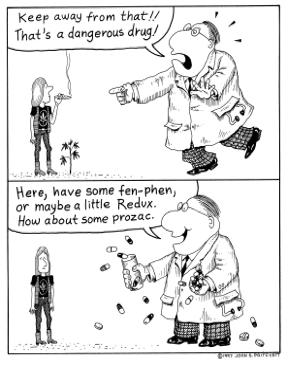
Even our drugs have a hierarchy. According to societal messages, alcohol is a good time. It can make you sexy, or even the most interesting person in the world. In general, it is a behavior that is rewarded by society. Despite what we learned about alcohol, it remains legal (once you are 21). By comparison, pot has historically been framed as bad, dangerous, even evil. And currently, it is illegal.


But it isn’t that simple for alcohol, either. To be a cool, suave social drinker is good, but to be an alcoholic is bad. If you binge drink with friends at a frat party, it is socially acceptable. If you binge drink alone, you are sick, and a problem that needs fixing.

How about our relationships? In general, though we know there are many, many forms of relationships, the ideal is two people, married, for love. Any other relationships are devalued, demonized or stigmatized. Some, in fact, are not legal.


That two person relationship (as long as it is heterosexual, married, and for love) is considered good. Being single, on the other hand, is bad - you must be lonely, and desperate, but don't worry--being single is always a temporary state, right? No one would want to be single, right?


I used this film as an example of this whole genre of films where the plot is “I’m a strong woman who is really into my career. But that’s just a cover up; what I really want is a man!” These films are almost a cautionary tale against choosing a career over love, and a reminder that to be single is pathetic. You must be unlovable if you can’t score a man! Remember, of course, that this only applies to women. If you are a man and single, you’re awesome! Suave..a player! And of course, don't forget how this image helps to keep the sexual double standard alive; she is looking for love in her mind, and he is looking for love in his pants.

Do not forget, of course, that a two-person relationship is the ideal...only if it is heterosexual.


But is same-sex behavior always bad? No way! Not when it’s two girls kissing!


But wait. It is good when two girls are kissing when they are young and feminine and men get to watch... But what if they are older? Or masculine? Or are not straight? What if it is because they dig each other? What if they’re not doing it for men’s pleasure, but they are doing it for their own?


In our society, lesbian women are bullied and harassed. But it is NOTHING compared to what happens to gay men. Lesbians are seen as far less threatening to masculinity and male power.

Remember the section of the course on bodies we consider deviant? In general, as you may remember, we consider able bodies (or at least bodies we perceived to be able) to be good, and differently-abled bodies to be bad. Who gets to make those decisions, on who is able-bodied and who is not? Who gets to draw the line? Though people with hearing impairments have an amazing amount of culture and history, and a beautiful language, because most people hear and use verbal language, we devalue sign language.


It is not that simple either, when it comes to people who are differently-abled. If you are young and cute and fit in with some of the archetypes, you can be good! But if you are old, or do not meet with our limited expectations, you are bad. We see a character like Artie, and we assume (1) he wants to walk, and (2) there is still hope for him. We look at the other guy, pictured below, and assume his life sucks. Hell, they even had to shoot him in black and white so we know to pity him! But maybe neither of these men feel like they are “disabled” or need to walk to have a fulfilling life. What would Mark Zupan say?


We also tend to think cisgender - good! Transgender - bad! This is one of the DVD covers for the film Transamerica. It was a hologram cover, where if you looked one direction, you saw Felicity Huffman as her beautiful cisgender self. When you looked at it another direction, you are supposed to be in shock and awe at the transformation Huffman had to undergo to become a transgender woman. The message is that transwomen are ugly, and masculine, and cannot possibly be sexy. That is not correct!


As we discussed this semester, within every subculture there is a good/bad undercurrent to keep everyone pitted against each other. Even in the transgender world there is good and there is bad. If you adhere to the gender binary, as a masculine transman or a very feminine transwoman - good!
If you are skinny and young - good!
If you are white - good!
But if you are not masculine or not feminine enough; if you’re fat or disabled or non-white...bad.


The woman pictured above is Duanna Johnson. A few years ago she was severely beaten by cops, which was caught on video. She filed a complaint and had to fight very hard to get taken seriously. Eventually, two cops were fired and the rest had to go through sensitivity training. A few months later she was found dead, shot in the head. Perhaps no surprise, there are no suspects. Transwomen, especially those who are not white, are routinely demonized, dehumanized, stigmatized and stereotyped as sex workers and drug addicts. Some of those stereotypes invade the transgender community itself, keeping them alive through internalized transphobia. There is a lot of pressure to "pass" as cisgender. There are similar and parallel pressures in a lot of marginalized communities, because of the ways we treat those who are perceived to be different.

These are, of course, just a few examples. I could make thousands of examples like these. In the end...we have made life almost impossible. The lines we draw between good and bad, between normal and deviant, are arbitrary. Fluid. Politicized.

And they totally change when you add in race, class, gender, ability, and so forth into the mix.

When we, as a society, insist upon a narrow definition of “normal” we make it so that almost nobody can fit into that definition.

Remember, it’s not the categories or the definition that is the problem, it is how we treat people based on those categories - it’s the social rankings we make. When the consequence of the label is to be shamed, humiliated, demonized, stigmatized, brutalized or even murdered...that is a problem.

Some of it is subtle, like a devaluation. An example is saying “that’s so gay." It is saying gay is bad, or dumb, or trivial. It’s subtle, perhaps, but it is devaluing, saying heterosexual > other options.

To say “he throws like a girl” is devaluing women as a way of insulting a male. It is saying to do something “like a girl” is a bad thing. Again, it may be subtle, but it is still devaluing, saying male > female.

Other times it is overt. For example, it is dangerous to be a transwoman of color in this country. One reason there is a pressure to "pass" as a cisgender woman is because of safety. Transwomen are killed, brutally murdered, at an alarming rate.

That’s when we need to think about our categories and hierarchies and ask ourselves why. Why do we have such a narrow definition of normal? And why are we so, so afraid of anything that could be seen as deviant?

Taking it back to kinks, what is so sexually exciting about what we label as deviant?
Think about the article I handed out the other day from the San Francisco Gate--maybe we all wish we could have a little more freedom to explore our deviance.

So I leave you with the question we have revisited often:

Do we as a society want a broad or narrow definition of normal?

April 10, 2012

UPDATE to Blog Post 5 and the Final Project!

The class has agreed to change up (and hopefully make easier) the rest of the semester.

First, instead of your Blog Post 5 (Deviance Debate) we will be having an in-class debate on April 24th. Blog Post 5 is worth 20 points. Those points will now be earned in the following way:
  • 5 points: Submit a potential debate topic, on Angel (see the "Deviance Debate" folder under the Lessons tab). Nominate a topic--one of the suggestions, or one of your own making--and briefly explain what you feel are the two "sides" of the debate we should take on. This is due Wednesday, April 11th by midnight and is available now.
  • 5 points: After I get all of the submissions, I will choose the top 5, and put them in the same folder on Angel, as a survey. You will need to vote for your top choice, out of those five.
  • 10 points: On the day of the Deviance Debate (April 24th) you will bring your arguments, ready to debate, to class. I will give you a handout in advance. You should have two solid arguments for each side, so four arguments total. If you are uncomfortable speaking in front of class, do not worry--your "side" will nominate spokespeople to represent that side of the argument.

As you can see, the total will be 20 points, so our grading scale will stay exactly the same. Still, this is a slight change to the syllabus. One that probably works to your advantage, in most cases. If you are uncomfortable with this in any way, please let me know as soon as possible.

Second, the Final Project will now be due April 29th. This gives you one more week. Remember that for the Final Project you are expected to expand upon your favorite blog post or posts, making them into a substantially different project than you originally had. You can expand one blog post, or combine two or three--you just need to make sure you are doing more than copying or pasting, as this is considered plagiarism (yes, you can plagiarize yourself).

Final Projects can be in the format of a Blog Post, or a traditional paper. If you go one of these routes, your final product must be between 2000 and 3000 words.

You also have a creative option, INSTEAD of writing a paper or Blog Post. You may make a video, a podcast, or a presentation--I am also open to other options. Please let me know by next Thursday (4/19) so I can make the schedule for April 26th. These should be 5 to 8 minutes long (or the equivalent, based on the format you choose). Talk to me if you have any questions.

April 5, 2012

Section 5 :: Deviant Behaviors Part II (April 10 – April 24)

NOTE: We are discussing body modification on April 19th. Do you have body modification? Are you willing to show and tell? If you are, please send me a photograph of your tattoo, piercing, branding or whatever body modification you have. Also tell me what it means to you, and/or why you got it. Also tell me if it is okay for me to use your name. If you do not want your identity known, no problem—just make sure we can’t tell from the photo. Please send these to me by April 15th (Taxes and tattoos—you can remember that, right?).

April 10th is the day we will be discussing non-vanilla sexual behaviors. Are you not sure what that means? You will want to be there, for sure! Remember you need to have your Homework 4 handout ready to turn in. If you don’t have that, email me ASAP to get one.
For today, come ready to talk about kinks and fetishes having read:

On April 12th, we will have the first of two days where we talk about same-sex sexuality and queerness. As I have touched upon in class, there is the behavior (same-sex sexuality) and the identities (lesbian, gay, bisexual, pansexual, queer, and so forth). As a deviance scholar, you know those are not the same thing. Until we give it a label, and a value judgment, it is just a behavior. If this seems hard to understand, look forward to the article by D’Emilio, when he talks about how the gay identity did not exist until the rise of capitalism allowed it to exist. The Schlatter and Steinback article takes on some of the common anti-gay myths you may have heard throughout your life. OK Cupid (yes, the dating site) takes it one step further, using data from their web site to answer questions about the LGBT visitors to their site (that’s the Rudder article). Once you’re done with all that reading, enjoy some Bisexuality Comics.
Optional:


On April 17th we will continue looking at queerness, and sexual identity. We will begin by looking at how heterosexuality became a sexual identity in a fascinating article by Katz. We will look at how complicated all this sexuality and gender stuff is with the short article about drag queens by Verta Taylor. We will question how useful “sexual orientation” is as a concept with a blog post by Lisa Wade. Then you get to see some photography from the Hide/Seek exhibit at the Smithsonian Institute’s National Portrait Gallery.

On April 19th, we will discuss at Body Modification. Is it deviant? What forms are deviant? Why do people get Body Modification? Is it a valid form of self-expression, or does it depend?
  • Read “Body Art, Deviance, and American College Students” by Koch and company. Available on Angel.
  • Read “Bodies of Change: A Comparative Analysis of Media Representations of Body Modification Practices” by Adams, also available on Angel.

You’re (WE are) almost done! On April 24th we will take on our last topic, Internet deviance. How has technology changed the way we do deviance? Is it ramping up deviance? Making deviance easier to find, or build community around? Should we fear technology as another way for some behaviors to flourish, or embrace it as a way to share common experiences? Do we need to worry about online predators? What do we have to do to protect the children?!?

We are DONE! :)

Is my professor deviant?

I just want to follow up today's discussion with some thoughts. It is hard to tackle such a big topic in less than one hour, but I absolutely loved all of your comments and thoughts. Thank you for sharing them!

I want to reiterate my role as a professor of a topic like deviance. This whole semester I have been talking about how we dehumanize people we see as the "other." We treat people that are different as sick, or something that we should pity, or fear. I am asking you, as a student of deviance, to push yourself past you gut reactions, or what you have been told your whole life, and try to look at those feelings from a sociological perspective.

I would be a terrible deviance professor if I treated the topics as deviant. To me, as a deviance scholar, and instructor, I need to treat everything as "normal" and let you decide for yourself if it should or should not be considered deviant. If I treat a topic as "oh gross, can you believe that?" I have reiterated it as deviant--that is the last thing I want to do.

I already know what the mainstream society is saying about that group, or that deviant status--I am trying to give you the one opportunity you may ever have to see the group, or person, or behavior as normal. At least that is what I try to do.

So I get a lot of very strong reactions--"I can't believe you feel that way!" or "You must be a kinky non-monogamist!" None of that matters--I don't think people should be shamed for feeling those ways, or being those ways, so I am not going to treat them as shameful.

Because I have this approach, however, I also get a lot of feedback "you don't give enough time to the mainstream perspective!" Again, we only have one day to tackle a lot of those topics. I already know you are getting the mainstream messages from a variety of sources. As your professor, it is my job to give you the other perspectives--the ones you do NOT hear in your every day life. I am aware that makes me look biased, and I think that is the risk I have to take to ensure you get new and challenging perspectives. Do not assume you know what I think, but do assume I am doing my best to give you the opportunity to challenge yourself.

We are all adults, and you are in a junior level course at an institution of higher learning. I expect you to be able to take a step back from what you have been told your whole life--what you heard from your father, your mother, your priest, your other teachers, your friends, et al.--and critically analyze your beliefs. WHY do you feel that way? It is okay to feel the way you do--of course--but it is crucial to your development as a critical thinker to question the foundation of those beliefs. Do not just rely on "because someone told me to think this way."

College is your opportunity to take a step back and see what forces have shaped your beliefs. That may change some of your beliefs, and it may strengthen others. That is great--making educated decisions is better than making uneducated one, don't you think? Embrace this class--and all of the difficult topics--as a way of understanding why you feel the way you do. As I said in the syllabus, and on the first day, an open mind makes for a much more interesting class. Not because I'm trying to necessarily change your mind, but because entertaining a variety of perspectives is a valid intellectual exercise. Synthesizing new information with what you already know is imperative in college, as well as the rest of your life--the topics in this class give you a great opportunity to practice this synthesis with fun topics. Take advantage. This course, even more than any other that I have taught, gives back as much as you are willing to put in. So dive in, be open, and challenge yourself. Push yourself out of your comfort zone. It is worth it.

March 28, 2012

Blog Post 5: Deviance Debates

In this course, and in our lives, we are constantly hearing about controversies and arguments around deviance. Some of the debates are about whether or not an attribute or behavior really is “deviant” and some are about what rights people should have if they are labeled “deviant.” In each section of this course we have uncovered (or will uncover) ongoing questions that correspond to current social and political debates, including a few I list at the bottom of this post.

For your final Blog Post, you are going to take on a question of deviance, and explain the current debate on the topic. You can choose from the list below, or find something else that interests you. Choose a topic based on a realistic ability to do a fair treatment of the arguments in the space allotted. Feel free to email me or meet with me about your choice, if you want help brainstorming. After you choose a topic, pick two sides of the debate—even though many of these are far too complex for just two sides—and explain what you see as the most convincing arguments on each.

First, pick a question. Briefly explain why you chose the topic, and explain how it relates to the course. Next, briefly explain the THREE best arguments for EACH side of the debate (there will be SIX arguments total). Last, take a stand! Let me know where you fall in the debate, and why, firmly grounded in the concepts of this course, NOT personal experience or opinion. Remember, this is an academic analysis of arguments, not an editorial. Keep the tone and language scholarly throughout the entire post.

To find the arguments, cull through all of the chapters of the book, and class materials. Make sure you pull out everything we have used in lecture, and the readings—look back at the theories, and all of the concepts we’ve discussed. You may also want to read ahead if you see a future article that pertains to your topic. Also do outside research to make sure you are finding the best possible arguments. As with your other Blog Posts, you must integrate, explain, and fully cite at least THREE of the readings from the class above and beyond the citations for the outside sources of your arguments (unless the reading is the source of your argument). Be sure you properly cite each and every source—remember, if it isn’t a thought that originated in your brain, cite it! Try your best to rely on academic sources, and only use informal sources (such as blogs) when you must. When you do use other sources, make sure you cite them properly.

This paper should be 600 to 1500 words in length, NOT including the Works Cited at the end, and must be posted by 9:00pm on April 29th. Be sure to proofread carefully—spelling and grammar issues detract from the points you are trying to make. If you are unsure of your writing in any way, I suggest seeking help from the Writing Center. They will provide free proofreading help, and can give you tips for organizing your writing. Push yourself to produce a post you can be proud of!

Potential Topics (choose one, or come up with your own!):
  • Should intersex babies be surgically assigned a sex category at birth?
  • Should we have separate high schools for LGBTQ students?
  • Should sex work be legal?
  • Should/can the United States legally recognize more than two genders?
  • Should same-sex marriage be legal?
  • Should polygamy be legal?
  • Is the “gay panic” or “trans panic” defense legitimate?
  • How young is too young to make a transgender transition?
  • What should be the age of consent for sexual activity?
  • Should police be patrolling bathrooms for people having consensual sex?
  • Should LGBTQ issues be discussed in schools? If so, starting at what age? Or, what types of topics?
  • How should schools handle transgender students and bathrooms?
  • Should [enter group here] be labeled as deviant?
  • Should there be regulations about how deviant people are portrayed in the media?
  • What is the best way to change a social norm? Through the culture, or policy?
  • Should sex offenders have to register? Should any other type of crime have a registry, also or instead?
  • What can we do to ensure members of minority groups get fair treatment in the criminal justice system?
  • Should some groups get special treatment in the criminal justice system, given their systematic disadvantage?
  • Should there be more/less regulation on media and/or products around weight loss?
  • What accommodations should institutions have to accommodate different levels of ability?
  • What is an appropriate age for a person to get a cochlear implant?
  • How can bullying best be stopped?
  • Should self-harm be legal or illegal?
  • What should be the age of consent for body modification?
  • Should we be working to reduce the prevalence of eating disorders? If so, how?
  • Are some kinks or fetishes harmful?
  • How can we change the stud/slut double standard? Or should we?
  • What can we do to stop sex tourism? Or should we?
  • Should someone be able to amputate a healthy limb if they want? Should they have to be diagnosed with Body Integrity Identity Disorder (BIID) first?
  • Should we see more models of average and above average size in mainstream media?
  • Should people with particular disabilities, sexual functioning and/or fetishes be able to legally hire specialized sex workers?

March 24, 2012

Section 5 :: Deviant Behaviors Part I (March 27 – April 5)

We have arrived at the final section of the course! After discussing deviant bodies and minds, we are ready to talk about behaviors that are considered deviant, to some degree, by mainstream society. The readings over the next few week are going to make you laugh, cringe, and perhaps shake your head a time or two. The more open you are, and the more willing you are to at least try to see everyone as “normal” for a moment (or at least more human than they are often treated) the more you may find yourself engaged with the stories and perspectives you are going to read, watch and hear. Have fun with this section, keeping your sociological imagination in high gear, and your critical thinking skills at full capacity.

March 27: We begin this exploration by discussing how two central social constructions impact how deviant we perceive sex to be—age, and gender. The “double standard” of slut vs. stud when it comes to gender is well known, but we are going to push even further into our understanding of how gender impacts our perceptions of deviance when it comes to sexual behaviors and practices. We are also going to discuss age, and how our perceptions of what it means to be certain ages also impacts our perceptions of what is deviant when it comes to sex. As you are reading about gender and age, you will also be exploring some of the most controversial questions about sexuality. How do groups (like women, or boy-loving men) work around the stigmas associated with their sexuality? Can pornography be feminist, or pro-female? Does one sexual encounter with a man make a man "gay" (and have you noticed we don’t ask that same question of women?)? What are the limits of the language and labels we use for sexuality? For today you will read the following:

On March 29 our two themes will be public sex, and the difficulties with legislating behaviors. We start with a groundbreaking article from author and activist Patrick Califia, on how laws draw a line in the sand, and impact our perceptions of sex. To keep you thinking about the complexities in deciding what is "public" and "private" using the example of bathrooms, I am also having you read a recent piece by author Ivan Coyote. It is a short piece; it is her an open letter to women that question her presence in bathrooms. Sex in Public Places offers more information about, and tips for, the practice.

You will also be reading an article by a peace and social justice activist Rubby Diesu who says the LGBTQ community is misguided in their feverish campaigning for “equality” in the form of same-sex marriage and the repeal of Don’t Ask Don’t Tell. Diesu asks: is that what we should be fighting for? For the LGBTQ community to give themselves up to heteronormativity? Can we ever be "equal" if we are supposed to assimilate? Think about what Califia says about the limits of laws when you read that article. In any social movement asking the public to change their perceptions of them, there will be some parts of the community that insist we have to focus on policies, and let social change trickle down. There is also usually a faction that says we need to change the social climate and culture, which will change policy, but also have more systemic changes in the broader culture. These articles will speak to that debate.

On April 3 we will ask the question: is sex work deviant? Is all sex work deviant? Does it depend on the type of work you are doing? Where do you draw the line? Based on behavior? Location? What happens when sex workers meet and organize?


April 5: Who says monogamy is the only valid option for a relationship? Why are we so stuck on monogamy as the ultimate type of relationship? Are there other options, that could be just—if not more—valid? Is the difficulty in other formats of relationship due to them being less valid, or due to the pressure of monogamy being the norm? Be prepared to debate the topic in class--I really want to hear what arguments stand out to you in these pieces.

March 22, 2012

Extra Credit to go to the WSUV Drag Show!

WSU Vancouver's Cougar Pride Club is sponsoring their 3rd Annual Drag Show, called "A Black Tie Affair" on March 29th. Doors open at 8:00, and the suggested donation is $5. It is being held in the Firstenberg Student Commons, and parking is free after 7:00. There will be various performances by drag queens and drag kings, including some performances by fellow WSU Vancouver students.

The etiquette of these shows is to enthusiastically watch--and tip--the performers! So come prepared with plenty of dollar bills to tip. If you can't afford this, don't let it stop you from attending, but it is the polite thing to do.

You can receive extra credit for attending, and writing up a one page (single-spaced) response to the event. Your response should include answers to the following questions:
  1. What did you think?
  2. How is drag a response to our social constructions of gender?
  3. Is drag deviant?

Only plan to attend if you are 100% sure you can maintain a safe space for the LGBT community that will be in attendance. If you can not respectfully handle the event, do the alternative assignment. If you are unable to attend because of work or family obligations, the alternative assignment is to read the article "Learning From Drag Queens" (available on Angel, in the readings from Section 5) and do a one page (single-spaced) write up. Please include the following in your write up:

  1. A brief history of drag.
  2. How is drag a response to our social constructions of gender?
  3. Is drag deviant?

Do Drugs and Alcohol Make You Sick?

Since we missed a day of class, I am turning Thursday's lecture into a blog post, so you can make sense of why I assigned the readings that I did. We will be discussing Tuesday's readings in class.

For Thursday, I asked you to read five short articles about drugs and alcohol. You may have wondered why I included these in a section on deviant minds. I think we all know that doing illegal drugs is considered deviant, to various degrees, and some of you may include alcohol in your personal definition of deviance. But I want to talk about drugs and alcohol from a different angle. How much is too much? How much consumption is "normal" and when does that cross over into too much? When is that too much considered fun, and when is it considered an illness, or a problem that needs to be fixed? Who gets to make those determinations?


If we were in class, I would ask you this question: is alcoholism/drug addiction an individual problem? Or a societal issue? As with the other topics we have discussed this semester, we have been sold an image in the United States that a person who drinks too much is sick. They can't help their consumption; it's a lifelong disease, with no cure.

So then let me ask you this: is drinking deviant? Think about how deviance is a social construction, in how it varies by time, person, location and context. The same behaviors you exhibit at 21 (give or take), such as binge drinking, are charming--even expected--when you are a traditionally-aged undergraduate (especially if you are in Pullman). Is it always charming? Do race, class, gender, size, ability or sexual orientation make a difference in how "deviant" or not that behavior is perceived? What happens when your 64-year-old professor shows up and gets in line to do a keg stand? Is that same behavior now a little suspect? A little....problematic? What assumptions do you start making about that professor, especially if she's a woman (spot check: what gender did you have in your mind when I said "professor"?)? Has drinking always been considered a problem? Or is that a relatively new construction? Would the same level of consumption be seen as deviant anywhere in the world? Look at how we have regulated alcohol consumption over time, as discussed in the article about the drinking age. As with other categories (like race, gender, size, ability, et al.) we have discussed this semester, age is a social construction. What behaviors and abilities we correlate with which ages are a fluid construction of our making, and the debates around the drinking age show that well.


In the United States, and now around the world, we have an organization called Alcoholics Anonymous. They have done tremendous work to help people stop drinking when they find it is interfering with their life in various ways. In no way do I want to diminish the work they do. I would like you, however, to take a step back and look at how they have shaped our understanding of alcoholism. They, along with a broader social movement, have given a set of behaviors a name (label), and have really changed the way we look at that label. At this point in our history, you are far more likely to see sympathetic portrayals of alcoholics, struggling valiantly with a disease than you would have seen a generation ago. They have been part of an overall reframing of alcohol consumption being a medical issue--they are part of an example of medicalization, as we have discussed in this section. In a way, they have switched the view of alcoholism from being an achieved status to an ascribed status, at some level.


Right now, you could take an online quiz somewhere, and it would tell you if you are an alcoholic. We have a whole list of behaviors that we see as "symptoms" signaling a "problem." And, luckily, groups like AA can offer you a solution. Unlike many of the groups we have discussed this semester, they are not offering their solution to make a profit. But they have created almost a monopoly on the solution. It's their program, or you're not fixing your problem correctly--even the criminal justice system seems to agree, when they mandate attendance at meetings.


What is the consequence of that medicalization? Now that we have these clearly defined symptoms, we see certain behaviors as pathological. Before, maybe you got an eyeroll. Now you get a headshake, and a court mandate. We believe people that drink too much--or in certain ways--are sick. That is a social construction, created by a social movement. Their intentions are positive, perhaps, but it still has consequences. Once you are labeled an alcoholic, that becomes your master status. You know the story from here.

That pathologization has spread to drug consumption in similar ways. Though drugs have been handled differently in our laws compared to alcohol, they too have been medicalized in our culture. Just like you can go to an AA meeting, you can go to a meeting for Narcotics Anonymous, or Crystal Meth Anonymous. Name your "problem" drug, and there is a 12 step solution for you out there. For every drug, there is a support group saying "we know, you couldn't help it, but now we can help you."

There is a positive and a negative impact from this pathologization. It takes the blame off of the individual, in one way, but puts it right back on them with the label of "sick." Is that a fair trade off?


Is drug use a problem? If so, how much is too much? How should it be regulated? Who should decide when it is too much, legally, or medically? How, as a society, should we handle drugs? How have we reacted to the use of drugs we have chosen to make illegal? Are some drugs more deviant than others? Does the deviant label depend on your race, class, gender, ability, et al.?


If you look at the billboards out there trying to stop people from doing crystal meth, they give a very particular message--don't use meth, because it will make you ugly. Are scare tactics the answer? If drugs are a problem, are scare tactics the answer? Research says that youth overestimate the impacts of cigarettes--they actually think they are more harmful than they really are. But that doesn't stop them from smoking. Smoking is cool, and youth often feel invincible.


Is it ever deviant to not do a drug? Is there a pressure to participate in some consumption, such as alcohol or pot? Why is pot a controlled substance? Has it always been illegal? Why is it still illegal? Pot is a great example of a form of deviance being a social construction. It wasn't illegal in the United States. And then it was. And how it became illegal was largely based in politics and lobbying, not for medical reasons, or because of crime problems. To justify making it illegal, the culture had to reframe the way they thought about pot. They had to start seeing it as a "problem" that needed to be controlled, in the eyes of the public, and in the ears of the legislators. Some groups helped to make this happen by using propaganda, including the infamous film Reefer Madness (1938), filled with scare tactics (you've got to protect the children!).


If you really dig into the history of how pot became illegal, you will see it wasn't to help society, it was to make money. And they used racist insecurities and fears to turn the country against a substance they once enjoyed, or at least viewed as neutral.


Why does a society control alcohol and/or drugs? Do we need the government to save us from ourselves? Or is it because controlling alcohol and/or drugs helps society? Certainly, drugs and alcohol cost society, in car accidents, health care, and lost productivity taking away from our economy. But are there also benefits to the consumption of drugs and alcohol?

I gave you two readings about the social harm of drugs. What does the most harm? If we are really legislating drugs to help society, why are we not controlling the drug that causes more harm than all the others, by far--alcohol? Who has the best political lobbyists? Who stands to make money by alcohol sales? If pot could make that much money for some people, would it suddenly be legal? If marijuana had the same political power as alcohol, what would happen? Would it be legal? Could it not just be legal, but woven into our culture as the ultimate party device, as alcohol is?


We have a twisted relationship with alcohol in our culture. We love it, it makes you sexy and cool, but don't drink too much....because that's sick. Why? Why are prescription drugs not treated the same way? Who can afford prescription drugs, and who can afford "street" drugs? How does that influence how we see deviance? Our definitions of deviance, when it comes to drugs and alcohol, are complex, and our messages often contradict each other.

March 6, 2012

Should the LGBT Community Use Words Like 'Faggot' And 'Tranny'?

Because we have been talking about language recently, and you recently wrote a blog post about this topic, I thought you might find this interesting. Huffington Post is starting a series called the Change My Mind debate series. The first installment came out today, and features a debate between two LGBT activists: Mara Keisling, the smart and wonderful Executive Director of the National Center for Transgender Equality, and Randall Jenson, the Executive Director of a documentary company called SocialScope Productions.

The debate article is fun, and different--you get to vote before you read each side of the debate, then dive into the two perspectives. Then, you get to vote again at the end. Give it a go!

As deviance scholars, it would be interesting to hear what you think--how did they do, defending each side? Did they hit all the major points? Did they bring in any arguments that surprised you, or were new to you? What was missing?

Diagnosis

First, from The Onion (satirical news source):


Here are the two parts of the Diagnosis podcast we listened to today. This is one episode of the amazing podcast RadioLab, which covers a host of scientific topics in an interesting, unique way. Seriously--the show blows my mind all the time. You will never think about some topics the same again!

The Frowners (about 18:00)

How to Cure What Ails You (the part we heard in class starts about 11:15 in) (10:15)

March 4, 2012

Final Project :: Due April 22


I want to talk about the Final Project now, to get it on your radar with plenty of time to consider your options. Your Final Project is worth 50 points toward your final grade, and is due by 9:00pm Sunday, April 22nd.

For your Final Project, you will choose your favorite Blog Post, and expand it into a final paper, post or presentation. It may be a temptation to just automatically choose the Blog Post 5, as it is due one week later, but I hope you will choose the project that engages you the most, not just the one that is most convenient.

Your Final Project will be more than an expansion; it will be a deeper examination of the same project, and the concepts it addressed. I expect you to fix any problems you had in the original post, incorporating the feedback I gave you, as well as helpful suggestions from your peers. Then I expect you to push deeper with your analysis, showing off all that you have learned, and your ability to engage with your project at an academic level. You may need to conduct additional research, and you will have to use more of the course materials. Instead of using only the materials from the section in which you wrote the post, you will have the entire semester's worth of materials from which to draw.

You must use, explain and fully cite at least FIVE of the course materials (anything from the syllabus) in your project. I will be looking for you to integrate the concepts and materials from the class in a way that shows clear understanding, and an ability to synthesize materials into new knowledge. Remember to explain concepts well, as if the audience reading your post is not me, but someone with no prior knowledge of social deviance. Also remember that if the thought did not originate in your head--whether it be a historical tidbit, a concept, an idea or a theory--you MUST cite the specific originator of that idea. Be respectful, be thorough, and do no plagiarize.

Because I extended the word count for the individual Blog Posts, I need to adjust the word count for the Final Project as well. Where the syllabus says 1500-2000 words, the Final Project should now be 2000-3000 words.

As I said above, your Final Project can be a paper, post or presentation.
  • If you want to do a traditional paper, it should be on double spaced pages, with full in text citations and a works cited. The font must be 12 inch (and comparable to a Times New Roman-type font), and the margins 1 inch. No cover sheet is necessary, but be sure to put your word count at the end.
  • If you want to do a post, you may want to type it into your word processing software first, for word count, as well as spell check. The expectation will be the same as for the paper when it comes to content, but this will allow you the creative freedom to use images, videos, links and so forth.
  • If you want to do a presentation, you have a few options. You can do a PowerPoint presentation, a podcast, a video, a web site, an academic poster, a pictorial...I am open. Please talk to me in advance so we can work out details, but plan on creating a presentation that lasts 5-8 minutes. Note: if you plan to do any of these options, please let me know by Tuesday, April 10th so we can discuss details, and make we leave sufficient time for presentations on April 26th.
To submit your Final Project:
  • Extended Blog Posts should be posted to your personal blogs.
  • Traditional Papers (or anything else you can turn in electronically) should be submitted to the Final Project Dropbox on Angel (under "lessons").
  • Presentations will be submitted through Dropbox if possible, or you can email me a URL if it is posted online somewhere. If you create something that is available online, please link to it from your blog.

I strongly, strongly suggest you utilize the Writing Center if you have struggled with any of your Blog Posts. This is a Final Project for a 300-level, upper division course. I expect you to have ZERO mistakes when it comes to spelling and grammar, no matter the format. I also expect your citations to be perfect. If you are not 100% sure you can do this, get help. I will be grading with the highest of expectations.

Best of the Blog Awards


As you are working on your next few blog posts....

And as you are reading the words of your classmates....

Keep in mind that at the end of the semester, you will be nominating your classmates for the Best of the Blog Awards! Here is your opportunity to be recognize, and be recognized, for your hard work and academic analysis this semester.

The categories for the awards are:
  • Best Writing: For this award, you will choose the blog that you thought showed the best writing ability. It could be because they were able to find that balance between keeping you academic, while they were teaching you. Or it could be because they brought the most unique voice. Be on the lookout for blogs that display great writing.
  • Best Use of Multimedia: For this award, you will choose the blog that used images and video, along with text, in the best ways. More than just throwing in fun images, they integrated multimedia into their posts to actually enrich the experience of reading their post, with humor, or for historic examples, or as a unique way to integrate other perspectives. As you are reading the blogs, take note of the ones that use multimedia well.
  • Best Use of Course Concepts: This award will recognize the blogger that gets it. This blogger weaves the course concepts into their posts so well, it is apparent they not only understand, but can take what we are learning to the next level. They explain things in a way you can understand, and also perhaps push you a little in your understanding.
  • Best Responder: Despite the fact that you were all forced to give both positive and negative feedback, this classmate did so with style. Their feedback was helpful, insightful, respectful, and helped further your understanding of the course concepts and materials. Whether they used humor, or just brought in a perspective you had not thought about, this award goes to the person who did the best job providing commentary on other blogs.
  • Best Overall Blogger: However you define "best" when it comes to our blogs, this is the award that will recognize the top blogger. It could be the person who made you laugh the most, made you think the most, pushed you the most, or just most consistently kept you engaged. As you read through all of the blogs, think about the posts that have lingered with you, and kept you thinking long after you've moved on to another post.
  • Best _________: This is a write-in category, where you get to make up the award. Feel free to be funny (but try to be respectful!). It could be anything from "best ideas" to "best research" to "best sense of humor" to "best grammar"...the possibilities are endless. I will choose a few of the best write-in awards, and those peers will be recognized with the other award winners.

Note: Because of the timing of the due date for the final Blog Post (April 29th), you will only be able to use the first FOUR blog posts to work with. Make your next Blog Post (and round of comments) count!

For your 5th and final homework assignment (worth 5 points), you will be nominating your peers for the Best of the Blog Awards. You will do so using a survey on Angel. It will come available Tuesday, April 17th at 9:00pm and will close Tuesday, April 24th at 9:00pm--you will have one week to make your nominations. The survey will be in a folder under "lessons."

March 2, 2012

Drug Trials in India

Here is a story that is just coming out today, on how drug testers are turning to the poor areas of India to do their drug testing, so they can workaround all of the rules we use in the U.S. to protect people during human drug testing.

'People keep falling sick': How Poor Indians are Recruited for Clinical Drug Trials

"Drug trial outsourcing to foreign countries is rapidly becoming an attractive alternative for U.S. pharmaceutical companies looking to save millions of dollars, avoid regulatory scrutiny and tap into a seemingly endless supply of drug study participants.

But a year-long Dateline investigation into one of the preferred destinations for overseas drug trials, India, raises questions about lax regulatory oversight in these studies, the integrity of some of the companies contracted to run them and the reliability of the data they produce. "

Read more here.

February 27, 2012

Unilever to save the day!

We have talked a bit about how much money can be made by making us feel insecure about our bodies (and minds!). We are made to feel so afraid of being "deviant" that this tactic works--if we were not so afraid of difference, we would not be so willing to spend to make ourselves "normal." Even the most informed consumers are left feeling doubt, when we have a constant barrage of messages telling us we are not measuring up to the ideals.

Unilever came up in class a couple of times, and I thought a few of you would appreciate this.

This is a clip from Steven Colbert's show, The Colbert Report. Here he discusses how Unilever socially constructs the problem of "unattractive armpits" and offers us a Dove product to save the day.


Dove (owned by Unilever) is a really interesting case. As was also pointed out in class, they were among the first companies to jump on the bandwagon when there was a public outcry against Photoshopping. The following commercial was beloved, and spread around like wildfire--they wanted women to believe they were on our side. And instead of making us feel bad about ourselves, they were going to save the day....by selling us their product. Was that progress, or more of the same clever marketing?


Don't forget, Unilever owns more than just Dove. They also own Axe (Lynx in some parts of the world), which has often been called out for their blatant objectification and hypersexualization of women, in their advertising.

Here is a great podcast I found a couple of years ago, that really talks about this new type of marketing--selling us female empowerment as a product, with profits still the ultimate goal.

Here are a couple other perspectives, and critiques of these, and similar, marketing ploys.


Blog Post 4: Story of an Illness

For this section of the course, we are talking about how some people get labeled "sick" for the way their minds work. This is an extremely difficult topic, with much emotion and controversy wrapped up in those labels. It seems that some behaviors people used to shrug off as somewhere in the range of "normal" are now considered problematic. And some behaviors that used to be seen absolute as a sign of mental illness (like homosexuality) are no longer perceived that way (at least by most).

For some, getting a label of a mental illness has been life-saving and affirmative. Not only does it offer them an explanation for whatever symptoms they have been experiencing, but it also offers a chance at treatment. And, because we rely so heavily on insurance, receiving an official diagnosis is often a necessary step for getting therapy and/or treatment. Being given a label has also meant that individuals facing similar issues, barriers and concerns can form community together, and bond over their common experiences. With all of our technological advancements, we keep learning more about the body, and our brains--so are these new and expanded labels helpful? Are they getting us closer to the truth?

One of the downsides to getting a label of mental illness is the stigma that comes with such labels. Such a stigma is potent, because, as we have discussed about labels, they come with a whole package of assumptions. We see people with mental illnesses as "sick" but what else comes in that package--sick? Crazy? Unstable? Dangerous? What happens when your mental illness becomes your master status? Once you have been labeled, are you seen the same by society? Do you still have the same opportunities as everyone else? Or do your choices become more constrained?

One of my favorite examples of this quandary--should we accept this label or not?--is in a really fascinating story of Emanuel Frowner, from the outstanding podcast Radiolab. In the story of the Frowners, the father of the family refuses to believe that Emanuel has any problems, but his other son can see that Emanuel has textbook symptoms along the autism spectrum. Dad wants to avoid Emanuel being treated differently, but his brother wants him to get help--what is ultimately the best thing for Emanuel? The story is moving, and even the comments on the web site are telling about how difficult these decisions are. The clip is about 19 minutes, and is well worth a listen (sorry about the ad!).

There are also more sides to this discussion. For example, who stands to benefit from more widespread diagnoses of mental illnesses? Certainly, pharmaceutical companies stand to make enormous amounts of money from some diagnoses. As we have touched upon in class, there is much more money to be made in treatment than prevention. Does having the potential for profits change the way such companies look at medicine? Are these companies doing great work to solve our health problems, are they looking at more markets to tap, are they impacting policy in powerful ways, or or is there even more going on? What should be the role of drug companies in educating doctors, or the public, about medicine?


The Diagnostic Statistical Manual (DSM) is called "the bible" when it comes to diagnosing mental illness. The DSM-V is scheduled to be released in May 2013 and the process of updating it has been nothing short of intense. Right now at least 8 conditions considered "disorders" will be removed. Various groups have lobbied, protested or fought in a myriad of ways to get their illnesses labeled, so they can get health care, or removed altogether. And those groups are infighting with each other, because some want the label to access health benefits, and others are fighting the stigmas. Should this be how diagnoses are made? By political lobbies and activism, or are decisions made based on sound scientific evidence? And who pays for that scientific evidence--it really gets that messy. On top of everything, many of the people charged with updating the new DSM-V clearly stand to make a lot of money on the very changes they are voting on--should this conflict of interest, which impacts up to 70% of the panel members, be allowed?

For your fourth blog post, you will do your best to disentangle all of this in regards to an "illness" of your choosing. You can choose something that used to not be labeled an illness, but is now, or something that is no longer considered an illness. Or something that is currently going through a surge of awareness, and heightened diagnoses, like autism or ADHD (both of which we will begin to discuss in class). Really, it can be any illness you want to know more about. More than giving a history, you are going to give us an analysis of what has been involved in the process of this illness gaining, or losing, that label. You are going to tell us the academic story of that illness.

Choose something that has been deemed an "illness" either informally, or formally in the DSM. Not necessarily eyelashes--try to take on something with broader implications. Give a brief history of the diagnosis, or medicalization of that illness, then give a sociological analysis of the illness, using questions like these:
  • What were the behaviors or attributes that were seen as deviant, and how did they become seen as deviant/normal?
  • What was the process of medicalization (or demedicalization?) for this illness?
  • Who were the major players in the decision-making process, as far as you can find?
  • What parties stand to gain from the diagnosis?
  • What parties stand to lose from the diagnosis?
  • Are the people that will be impacted by the label part of the conversation, at all?
  • How did/does information spread about this illness?
  • What were/are the roles of social institutions in creating/maintaining the "sick" label?
  • What are the consequences (positive and negative) of having this diagnosis?
  • Are some groups more or less likely to be diagnosed with this illness?
  • What are the underlying social constructions of race, class, gender, size, ability, sickness, mental health, age, beauty, normal, deviance, sexuality, and so forth that impact this illness, and/or its perception?
  • Once this label is assigned, do we as society take any responsibility for the care of those who are labeled? Should we?
  • Who benefits from this illness being seen as an individual problem?
  • What are the possible social reasons for the existence of this illness?

A thorough post will include as many sides of the discussion as possible, to try to show just how complex this all is, and will do a really solid job of connecting to the concepts and materials from the course to their examination. My standards are only increasing; if you have any doubts, make sure you visit the writing center. At this point we should be past any typos or citation errors. Remember you must utilize and cite at least three of the assigned course materials, and you must EXPLAIN sufficiently how they connect to your analysis.

Not sure where to start? Here are a few suggestions, and some links to some places to start your thinking (also, of course, look at the required readings). Once you choose one, if you need some guidance, feel free to email me and/or set up a time to talk--I am always happy to bat around ideas with students. You will probably find you need to go back into the deviance blogs, so you can make sure you are getting a wide representation of perspectives and voices on the impact of these deviant labels (see the list on the right side of the page).

This is not necessarily reflective of what is "out there" but is just pulled from my personal collection I have gathered over the past few years of teaching this course.

Autism/Asperger's
ADD/ADHDGender Identity DisorderHomosexualityAlcoholism/Drug AddictionObesityDepression/Mental Illness (sorry to lump these--please be more specific in your own project)
Developmental, intellectual or physical disabilities (sorry to lump these--please be specific for your own project)
Sex AddictionViolenceBonus thoughts: