Showing posts with label social construction. Show all posts

March 24, 2012

Section 5 :: Deviant Behaviors Part I (March 27 – April 5)

We have arrived at the final section of the course! After discussing deviant bodies and minds, we are ready to talk about behaviors that are considered deviant, to some degree, by mainstream society. The readings over the next few week are going to make you laugh, cringe, and perhaps shake your head a time or two. The more open you are, and the more willing you are to at least try to see everyone as “normal” for a moment (or at least more human than they are often treated) the more you may find yourself engaged with the stories and perspectives you are going to read, watch and hear. Have fun with this section, keeping your sociological imagination in high gear, and your critical thinking skills at full capacity.

March 27: We begin this exploration by discussing how two central social constructions impact how deviant we perceive sex to be—age, and gender. The “double standard” of slut vs. stud when it comes to gender is well known, but we are going to push even further into our understanding of how gender impacts our perceptions of deviance when it comes to sexual behaviors and practices. We are also going to discuss age, and how our perceptions of what it means to be certain ages also impacts our perceptions of what is deviant when it comes to sex. As you are reading about gender and age, you will also be exploring some of the most controversial questions about sexuality. How do groups (like women, or boy-loving men) work around the stigmas associated with their sexuality? Can pornography be feminist, or pro-female? Does one sexual encounter with a man make a man "gay" (and have you noticed we don’t ask that same question of women?)? What are the limits of the language and labels we use for sexuality? For today you will read the following:

On March 29 our two themes will be public sex, and the difficulties with legislating behaviors. We start with a groundbreaking article from author and activist Patrick Califia, on how laws draw a line in the sand, and impact our perceptions of sex. To keep you thinking about the complexities in deciding what is "public" and "private" using the example of bathrooms, I am also having you read a recent piece by author Ivan Coyote. It is a short piece; it is her an open letter to women that question her presence in bathrooms. Sex in Public Places offers more information about, and tips for, the practice.

You will also be reading an article by a peace and social justice activist Rubby Diesu who says the LGBTQ community is misguided in their feverish campaigning for “equality” in the form of same-sex marriage and the repeal of Don’t Ask Don’t Tell. Diesu asks: is that what we should be fighting for? For the LGBTQ community to give themselves up to heteronormativity? Can we ever be "equal" if we are supposed to assimilate? Think about what Califia says about the limits of laws when you read that article. In any social movement asking the public to change their perceptions of them, there will be some parts of the community that insist we have to focus on policies, and let social change trickle down. There is also usually a faction that says we need to change the social climate and culture, which will change policy, but also have more systemic changes in the broader culture. These articles will speak to that debate.

On April 3 we will ask the question: is sex work deviant? Is all sex work deviant? Does it depend on the type of work you are doing? Where do you draw the line? Based on behavior? Location? What happens when sex workers meet and organize?


April 5: Who says monogamy is the only valid option for a relationship? Why are we so stuck on monogamy as the ultimate type of relationship? Are there other options, that could be just—if not more—valid? Is the difficulty in other formats of relationship due to them being less valid, or due to the pressure of monogamy being the norm? Be prepared to debate the topic in class--I really want to hear what arguments stand out to you in these pieces.

March 22, 2012

Do Drugs and Alcohol Make You Sick?

Since we missed a day of class, I am turning Thursday's lecture into a blog post, so you can make sense of why I assigned the readings that I did. We will be discussing Tuesday's readings in class.

For Thursday, I asked you to read five short articles about drugs and alcohol. You may have wondered why I included these in a section on deviant minds. I think we all know that doing illegal drugs is considered deviant, to various degrees, and some of you may include alcohol in your personal definition of deviance. But I want to talk about drugs and alcohol from a different angle. How much is too much? How much consumption is "normal" and when does that cross over into too much? When is that too much considered fun, and when is it considered an illness, or a problem that needs to be fixed? Who gets to make those determinations?


If we were in class, I would ask you this question: is alcoholism/drug addiction an individual problem? Or a societal issue? As with the other topics we have discussed this semester, we have been sold an image in the United States that a person who drinks too much is sick. They can't help their consumption; it's a lifelong disease, with no cure.

So then let me ask you this: is drinking deviant? Think about how deviance is a social construction, in how it varies by time, person, location and context. The same behaviors you exhibit at 21 (give or take), such as binge drinking, are charming--even expected--when you are a traditionally-aged undergraduate (especially if you are in Pullman). Is it always charming? Do race, class, gender, size, ability or sexual orientation make a difference in how "deviant" or not that behavior is perceived? What happens when your 64-year-old professor shows up and gets in line to do a keg stand? Is that same behavior now a little suspect? A little....problematic? What assumptions do you start making about that professor, especially if she's a woman (spot check: what gender did you have in your mind when I said "professor"?)? Has drinking always been considered a problem? Or is that a relatively new construction? Would the same level of consumption be seen as deviant anywhere in the world? Look at how we have regulated alcohol consumption over time, as discussed in the article about the drinking age. As with other categories (like race, gender, size, ability, et al.) we have discussed this semester, age is a social construction. What behaviors and abilities we correlate with which ages are a fluid construction of our making, and the debates around the drinking age show that well.


In the United States, and now around the world, we have an organization called Alcoholics Anonymous. They have done tremendous work to help people stop drinking when they find it is interfering with their life in various ways. In no way do I want to diminish the work they do. I would like you, however, to take a step back and look at how they have shaped our understanding of alcoholism. They, along with a broader social movement, have given a set of behaviors a name (label), and have really changed the way we look at that label. At this point in our history, you are far more likely to see sympathetic portrayals of alcoholics, struggling valiantly with a disease than you would have seen a generation ago. They have been part of an overall reframing of alcohol consumption being a medical issue--they are part of an example of medicalization, as we have discussed in this section. In a way, they have switched the view of alcoholism from being an achieved status to an ascribed status, at some level.


Right now, you could take an online quiz somewhere, and it would tell you if you are an alcoholic. We have a whole list of behaviors that we see as "symptoms" signaling a "problem." And, luckily, groups like AA can offer you a solution. Unlike many of the groups we have discussed this semester, they are not offering their solution to make a profit. But they have created almost a monopoly on the solution. It's their program, or you're not fixing your problem correctly--even the criminal justice system seems to agree, when they mandate attendance at meetings.


What is the consequence of that medicalization? Now that we have these clearly defined symptoms, we see certain behaviors as pathological. Before, maybe you got an eyeroll. Now you get a headshake, and a court mandate. We believe people that drink too much--or in certain ways--are sick. That is a social construction, created by a social movement. Their intentions are positive, perhaps, but it still has consequences. Once you are labeled an alcoholic, that becomes your master status. You know the story from here.

That pathologization has spread to drug consumption in similar ways. Though drugs have been handled differently in our laws compared to alcohol, they too have been medicalized in our culture. Just like you can go to an AA meeting, you can go to a meeting for Narcotics Anonymous, or Crystal Meth Anonymous. Name your "problem" drug, and there is a 12 step solution for you out there. For every drug, there is a support group saying "we know, you couldn't help it, but now we can help you."

There is a positive and a negative impact from this pathologization. It takes the blame off of the individual, in one way, but puts it right back on them with the label of "sick." Is that a fair trade off?


Is drug use a problem? If so, how much is too much? How should it be regulated? Who should decide when it is too much, legally, or medically? How, as a society, should we handle drugs? How have we reacted to the use of drugs we have chosen to make illegal? Are some drugs more deviant than others? Does the deviant label depend on your race, class, gender, ability, et al.?


If you look at the billboards out there trying to stop people from doing crystal meth, they give a very particular message--don't use meth, because it will make you ugly. Are scare tactics the answer? If drugs are a problem, are scare tactics the answer? Research says that youth overestimate the impacts of cigarettes--they actually think they are more harmful than they really are. But that doesn't stop them from smoking. Smoking is cool, and youth often feel invincible.


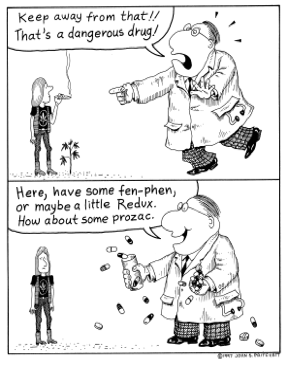
Is it ever deviant to not do a drug? Is there a pressure to participate in some consumption, such as alcohol or pot? Why is pot a controlled substance? Has it always been illegal? Why is it still illegal? Pot is a great example of a form of deviance being a social construction. It wasn't illegal in the United States. And then it was. And how it became illegal was largely based in politics and lobbying, not for medical reasons, or because of crime problems. To justify making it illegal, the culture had to reframe the way they thought about pot. They had to start seeing it as a "problem" that needed to be controlled, in the eyes of the public, and in the ears of the legislators. Some groups helped to make this happen by using propaganda, including the infamous film Reefer Madness (1938), filled with scare tactics (you've got to protect the children!).


If you really dig into the history of how pot became illegal, you will see it wasn't to help society, it was to make money. And they used racist insecurities and fears to turn the country against a substance they once enjoyed, or at least viewed as neutral.


Why does a society control alcohol and/or drugs? Do we need the government to save us from ourselves? Or is it because controlling alcohol and/or drugs helps society? Certainly, drugs and alcohol cost society, in car accidents, health care, and lost productivity taking away from our economy. But are there also benefits to the consumption of drugs and alcohol?

I gave you two readings about the social harm of drugs. What does the most harm? If we are really legislating drugs to help society, why are we not controlling the drug that causes more harm than all the others, by far--alcohol? Who has the best political lobbyists? Who stands to make money by alcohol sales? If pot could make that much money for some people, would it suddenly be legal? If marijuana had the same political power as alcohol, what would happen? Would it be legal? Could it not just be legal, but woven into our culture as the ultimate party device, as alcohol is?


We have a twisted relationship with alcohol in our culture. We love it, it makes you sexy and cool, but don't drink too much....because that's sick. Why? Why are prescription drugs not treated the same way? Who can afford prescription drugs, and who can afford "street" drugs? How does that influence how we see deviance? Our definitions of deviance, when it comes to drugs and alcohol, are complex, and our messages often contradict each other.

February 27, 2012

Unilever to save the day!

We have talked a bit about how much money can be made by making us feel insecure about our bodies (and minds!). We are made to feel so afraid of being "deviant" that this tactic works--if we were not so afraid of difference, we would not be so willing to spend to make ourselves "normal." Even the most informed consumers are left feeling doubt, when we have a constant barrage of messages telling us we are not measuring up to the ideals.

Unilever came up in class a couple of times, and I thought a few of you would appreciate this.

This is a clip from Steven Colbert's show, The Colbert Report. Here he discusses how Unilever socially constructs the problem of "unattractive armpits" and offers us a Dove product to save the day.


Dove (owned by Unilever) is a really interesting case. As was also pointed out in class, they were among the first companies to jump on the bandwagon when there was a public outcry against Photoshopping. The following commercial was beloved, and spread around like wildfire--they wanted women to believe they were on our side. And instead of making us feel bad about ourselves, they were going to save the day....by selling us their product. Was that progress, or more of the same clever marketing?


Don't forget, Unilever owns more than just Dove. They also own Axe (Lynx in some parts of the world), which has often been called out for their blatant objectification and hypersexualization of women, in their advertising.

Here is a great podcast I found a couple of years ago, that really talks about this new type of marketing--selling us female empowerment as a product, with profits still the ultimate goal.

Here are a couple other perspectives, and critiques of these, and similar, marketing ploys.


February 21, 2012

How Realistic is Our Beauty Ideal?

We have talked quite a bit about the "ideal man" and "ideal woman" this semester. At the end of class today we started to touch on how our images of the ideal contain expectations for what men and women are supposed to look like. How realistic are our ideals? Should all women be rail thin, with big breasts? Should all men be muscular? Where do those ideals come from, and how do they relate to the other social constructions we have for race, class, gender, sexuality, size, ability, and so forth? What do we mean by "fat"? How has that definition changed over time? As I would like to explore in this post, are those ideals even realistic? If we are all being held to a standard, how possible is it for any of us to reach that standard?

Check out this gallery of celebrity images that have been touched up using Photoshop.


It is such a well known practice to use Photoshop to alter images, the United Kingdom has controls in place, calling the use of such techniques "misleading."

Here is a spoof ad about the practice:

Fotoshop by Adobé from Jesse Rosten on Vimeo.


While being overweight has different social consequences for men than women, there is still a lot of pressure on men to display masculinity a certain way, through their appearance. As your classmate pointed out, men get grief for being too skinny. They also get grief for being too fat, as we saw in the ads from the first day of class. Just like you see before/after pictures to "motivate" women to buy products, you see before/after pictures promising impossible results at a cost for men. How realistic are those?


The formula is pretty clear. Create an insecurity, offer a solution, rake in the money. Think about the trend of making men worry about their height and the products offered to "solve" that socially constructed problem. What are the consequences of height being seen as a "problem" for men? Short men are perceived differently from tall men:


As some of your clever classmates pointed out today, there is a LOT of money to be made selling people the solutions to their insecurities, so there is an investment in keeping people insecure, as well as fabricating new reasons to be insecure. These messages--that we should feel shame if we are fat, or fear that we will die lonely if we are short--are part of the slow drip we receive our whole lives, reminding us we need to be normal at all costs, and fear that which is deviant.

February 7, 2012

Blog Post 3: Deviant Blogging & The Importance of Language


Photo credit: http://vintage-ads.livejournal.com/3130862.html

Language evolves. The meanings of words change over time. In the image above, the word "gay" meant happy, and the rainbow did not have the same connotations it does now. Words, and how they are used, are another example of
social constructions. The meaning of the same word can vary over time, by location, by context, and by the person saying/hearing it.

For your third blog post, you will be looking at blogs written by people who have been labeled deviant, and you will teach us what they think about language. Not language in general, but how some words that relate to deviant labels have value attached to them. Some groups are asking us to stop using certain words (such as "the r word"), while other groups are reclaiming (often called reappropriating) words (such as "queer"). For your post, you will research the history of a word or phrase, and find out deviant bloggers (members of deviant communities) are saying about that word. These words or phrases could have come from identities or assumptions about gender, race, class, sexuality, gender identity, occupation, ability level, size, or anything else that marks a person or group as "other" from the default.

If you think about most of the insults we throw around at each other, they can often be traced back to a group or status that is considered "deviant" in our culture. When we do not like something, we may call it "lame." That word, as innocuous as it seems, has a meaning--to be lame is to have difficulty walking. So when you say something is lame, you are referring to a physicality that would fall under the umbrella of disability.


Think about the word in the image above--gay. To be gay meant to be happy (well, it still does), but in the 1940s (according to the Online Entomology Dictionary) it started to also be used as slang for homosexual. If you look at the word "gay" now, it is a pretty safe word to use to talk about someone who identifies as a gay male--and in fact is considered "more updated" language than calling someone homosexual. But some members of the LGBTQ (lesbian, gay, bisexual, transgender, and queer/questioning) community feel that calling anyone in the community "gay" is lumping everyone together too much, because it erases gender and individual identities (such as lesbian, and bisexual) and one's gender identity (e.g. being transgender) has NOTHING to do with their sexual orientation (such as gay, lesbian or bisexual). You also very frequently hear "that's so gay" used as an insult, so there are several campaigns asking people to stop using "gay" in a negative way. So for some people, "gay" has been reclaimed as a positive word. But for others, "gay" should only be used to describe gay men, and is otherwise insulting, and for others still, "gay" should only be used in reference to someone's sexual identity, and only in positive or neutral ways.


We have read (or will read) two articles that may help get you thinking about the emotions and power behind language: the article by Kelly Osbourne, and the post about ableist language. There are articles and debates all over the blogosphere about reclaiming words, such as this post about reclaiming the word "slut" and this encyclopedia entry on the reclaiming of "Jesus Freak" among Christian youth.

For your blog post, choose a word or phrase that is currently, or has been, used in the United States an insult that refers to a group that is perceived as deviant. You have seen examples in class, or you can listen around for ideas, or feel free to come talk to me. You could also start here.

Once you have chosen the word or phrase:
  • Explain the history (entomology) of the word or phrase. Some words will be easier to research than others--do the best you can.
  • What used to be the connotations?
  • What are the current connotations?
  • Who is more or less likely to use this word or phrase?
  • What are the underlying social constructions in that word or phrase?
  • What communities are impacted by the use of this word or phrase?
  • How do members of the relevant communities feel about the word or phrase? Are some people reclaiming the word? Are others asking us to stop using the word?
  • Is it a word that is more or less acceptable to use if you have a certain deviant label (you are a member of that community)? For example, in the LGBTQ community, some people use words like "fag" or "dyke" to describe themselves or others in the community. If you are not part of the community, however, you may be sanctioned for using those words--at the very least, those same words may be seen as insulting.
This is not meant to be exact checklist or outline for your paper, but you should find a way to answer each of those questions in your thoughtful, academic analysis.

Explore the Deviance Blog List on the right side of this screen for ideas, and for research into the power of the word/phrase on the communities impacted. These blogs may not give you the exact information you need, but can hopefully get you started and thinking in your search.

Remember, blog posts should be between 600 and 1500 words, and citations are necessary. See blog post tips, if you do not remember. You must also integrate and cite at least THREE of the assigned readings/sites/videos from the course materials.

Note: as we will be learning, some of these words are very loaded! You are wading directly into controversy, insults, and people's humanity. Please be respectful in your analysis, and how you choose to discuss the word or phrase in your blog. People may stumble across your blog, and it is not our goal to traumatize anyone--be kind, compassionate and professional.

February 3, 2012

Section 3 :: Deviant Bodies (Part II: Feb 14, 16 and 21)

For the last three days of this section, we are going to be discussing other types of deviant bodies. We are going to discuss our obsession with size, and the beliefs we have about overweight bodies. Then, we are going to discuss bodies that are seen as disabled, and the limits of our beliefs about what constitutes "ability" and "disability."

As with all of the groups we discuss this semester, members of the fat and disability community are both challenging us to think about how we define "normal." In our images of ideal men and women, we have very specific ideals for what we think bodies should look like, and how they should function. If you look around, you will see that almost all aspects of our culture is based on an assumption that we meet the ideal, or pretty close. Look at the classrooms on campus--do the chairs, desks and rows make assumptions about your body size and shape? What are they assuming about your physical abilities? Next time you go to a store, look--would you be able to get into the store, if you were in a wheelchair? Does the layout of the store make assumptions about your body, in size and ability? If they sell clothing, do they sell clothes that would fit any type of body, based on size or ability?

Both weight and ability are a master status, so when you are not the ideal size (which has nothing to do with averages, or reality), or have a visible disability (which has nothing to do with your actual capacity), you are seen first and foremost by that status. Your actions and words get put through the filter of assumptions we have about fat and disabled bodies. For example, in both communities, there is a perception that when you are fat or disabled, you are asexual. Mainstream society has a hard time believing you can be attractive, attracted and sexual. You are considered deviant if you want to have sex with someone fat or disabled. Why? What are the underlying assumptions and social constructions? How does this relate to our ideas of "ideal women" and "ideal men"?


On February 14, we will talk about fat bodies (I use the term "fat" in reference to the fat acceptance movement). We will ask where our beliefs about people who are fat come from, what that means for the lives of those who receive the "fat" label, and the consequences of the stigma that comes with that label.

Required:


On February 16, we begin talking about people with disabilities, and our assumptions behind that label. What constitutes "abled" or "disabled" and who gets to choose where to draw the line between those two labels? Some people get from point A to point B by walking. Others roll. Who says one way is better? How does all of this work with our images of the ideal man and woman? What are the consequences of being labeled "disabled" in our society? What do we think we know about people, based on their disability as a master status?

Required:


On February 21 we will finish this section of the course by watching the film Murderball and completing our discussion of what it means to be able-bodied. Be excited to see this documentary--not only will it blow you away, but the star of the film Mark Zupan will be coming to WSUV as the Marquee Diversity speaker on March 7! Here are the details. Reserve your seats now!

Required:


Bonus: Mark Zupan in Jackass Number Two!

January 24, 2012

Policing Behavior Through Labels

Today we got to talk about the power of labels. As we discussed, labels are a shortcut. They are a way that we maintain beliefs about race, class, gender, ability, size, sexuality and so forth. We also use them when we want to imply something about the person we are labeling, not just their behavior. Some of you had some really great analysis on your homework handouts.


For example, one of you talked about the label "bitch." As your classmate expressed so well, this label is "used to express scorn for a woman overstepping the bounds of feminine submissiveness. Men (and other women) expect women to be passive and to get along with others, and deviation from this expectation is met with a negative reaction." Great way to say it! This label is a great example of the way we use labels to try to keep people in their expected roles, even if those roles are just based in stereotypes. We punish aggression in women by using this word.

Another way we police gender is using the label "tomboy," as one of you pointed out. As this classmate said: "A tomboy challenges emphasized femininity, or what/who women are supposed to do/spend time with. In our society girls are supposed to have girl friends and only have romantic relations with boys, not platonic ones." If you think about all that is packed into that sentence, we use "tomboy" to monitor a lot of beliefs we have about women and girls. First, women and girls are supposed to care about relationships. But, they are supposed to have friendships with girls, as the assumption is heterosexuality--boys are for dating. Also think about the implications of how it is acceptable for a young girl to be masculine, but it is less acceptable for an adult woman. Also, when the reverse happens, and a young boy is seen as feminine, red flags go up. Everyone thinks he must be gay. There is much less tolerance for this option, and parents will even try to "fix" this. Here is the story of one mom that dared to challenge that, and the backlash she faced.

Labels can be powerful. One of you talked about the label of "welfare mom" which I think is a leftover relic of the "welfare queen" stereotype created by Ronald Reagan during his 1976 campaign that still seems to linger. When you call someone one of those labels, you are diminishing their entire existence into a package of assumptions tied up in race, class, gender and so forth. Labels can be funny (c'mon--eye broccoli?!?)...but they come with assumptions. Some can be harmless, but often they are based in assumptions that just aren't true, and by using them, we are keeping stereotypes alive. No one wants to be boiled down to a few inaccurate assumptions, no matter our race, class, gender, ability level, and so forth. Who says a "meathead" can't also be a smart, hardworking student? Who says redheads have to be misfits?

January 10, 2012

Ideal Women and Men

Today we talked about the mainstream U.S. ideals for women and men. What do you think of what your classmates came up with? What is missing, if anything?


We will come back to these ideals throughout the semester. We will discuss how we judge others and ourselves based on these "ideals" whether they are achievable, realistic, healthy, good for society, or not. When you do not match with the ideal, you are considered deviant in our society.

We will also discuss how people who identify with the attributes you listed are "the default." One way to think about this is a quick exercise. When you read the word "gender" what comes to mind? For most people in our society, we think "women" or "female." Men have a gender as well, but they are the default. We think of them as neutral, and women as gendered. When you read the word "race" what comes to mind? For most people, we think "African American" or "Asian American" or "Native American" and so forth. Caucasians have a racial categorization as well, but that is not what we think about when we think race. Same with sexual orientation--isn't heterosexual an orientation? When you meet up with the ideals on these lists (white, male, heterosexual, Christian, and so forth) you are seen as neutral; the "default". Everyone else is "the other."

January 6, 2012

Section 1 :: Who/What is Deviant?

For the first two weeks of class (January 10 - January 19), we will be discussing who and what is considered deviant in society. While we will discuss how definitions of what is "normal" and "deviant" varies widely by geographic area, for this course, we will primarily be focused on the United States.

Remember, you are expected to have read, watched and digested all of the assigned items, and be ready to discuss them in class on the date listed. There will be times when we do not discuss those concepts on the exact date, but we will eventually, and you are expected to keep up, and contribute mindfully.

For January 12 you will be exploring the topic of privilege. This is a difficult topic for many, and puts a lot of people on the defensive. Right out of the gate, you are going to find out you need to have an open mind to enjoy this class. The concept of privilege refers to the "unearned advantages" some people get, and some people do not, just because of their race, class, gender, ability, size and so forth. This concept will be fundamental to our future explorations in this class, so make sure you have a good grasp, and come to class with questions.


These articles will also begin to touch on the concept of master status. Our master status is the first thing people notice about us, and use to determine who we are. When you are 18-22 and walking around campus with a backpack, people think "student" and from there, they assume attributes that go along with the role of "student" such as busy, tired, or party animal (well, hopefully not). When you are something that is considered "deviant" by society, that often becomes your master status, or your defining attribute. When you are in a wheelchair, that is the first thing people see about you, and they will make a host of assumptions based on your status as a person with disability. Maybe they will feel sorry for you. Maybe they will think you must be SO brave. When you say something, they will filter your words through "well, he or she is saying that as a person in a wheelchair." We will talk about this much more in class. You will see that these concepts are connected. When you are labeled "deviant" in our society, you are seen in terms of your master status. When you are seen as "normal" you are not--and that is a privilege. In your assigned items, you will see two "privilege checklists." These were inspired by this article: White Privilege: Unpacking the Invisible Knapsack by Peggy McIntosh.

Required
What is cisgender? It is someone who identifies with the gender assigned to them at birth. Learn more here.
Optional:
On January 17 we will start discussing how what we consider "deviant" is really just a social construction. For example, what we consider to be "deviant" changes greatly over time. It used to be considered deviant for women to wear pants. Now it is "normal." Cocaine used to be a popular medical remedy, now it is illegal. We will discuss many more examples in class, and I would also love for you to think of your own to share with us. We will talk about social constructions in general, how "deviance" is one, and what the consequences are of being labeled deviant. We will also be discussing who gets to decide who and/or what is considered deviant.

Required:
  • Read "Images of Deviance" by Stephen Pfohl in your textbook.
  • Read "Defining Deviance Down" by Daniel Patrick Moynihan in your textbook.
  • Read "Outsiders: Defining Deviance" by Howard Becker, available on Angel.
  • Read "Stigma of Having Obese Friends" on BBC News.
On January 19 we will complete this section, talking about WHO we consider deviant in our culture and HOW we know they are. Come prepared to talk about the following items:

Required:
  • Read "The Saints and the Roughnecks" by Williams Chambliss, available on Angel.
  • Peruse the blog Microagressions. The posts change frequently, so consider looking back a few times. Come to class prepared to talk about the ones you found most interesting, disturbing and/or confusing.
  • Listen to the clip "Spinal Muscular Atrophy 'Doesn't Define Me'" on NPR (transcript available on the same page).
  • Read the article "Media Binge" from the sociological journal Contexts.
  • Watch both of the following clips from ABC's "What Would You Do?"
Part 1:

Part 2: