Showing posts with label master status. Show all posts

March 22, 2012

Do Drugs and Alcohol Make You Sick?

Since we missed a day of class, I am turning Thursday's lecture into a blog post, so you can make sense of why I assigned the readings that I did. We will be discussing Tuesday's readings in class.

For Thursday, I asked you to read five short articles about drugs and alcohol. You may have wondered why I included these in a section on deviant minds. I think we all know that doing illegal drugs is considered deviant, to various degrees, and some of you may include alcohol in your personal definition of deviance. But I want to talk about drugs and alcohol from a different angle. How much is too much? How much consumption is "normal" and when does that cross over into too much? When is that too much considered fun, and when is it considered an illness, or a problem that needs to be fixed? Who gets to make those determinations?


If we were in class, I would ask you this question: is alcoholism/drug addiction an individual problem? Or a societal issue? As with the other topics we have discussed this semester, we have been sold an image in the United States that a person who drinks too much is sick. They can't help their consumption; it's a lifelong disease, with no cure.

So then let me ask you this: is drinking deviant? Think about how deviance is a social construction, in how it varies by time, person, location and context. The same behaviors you exhibit at 21 (give or take), such as binge drinking, are charming--even expected--when you are a traditionally-aged undergraduate (especially if you are in Pullman). Is it always charming? Do race, class, gender, size, ability or sexual orientation make a difference in how "deviant" or not that behavior is perceived? What happens when your 64-year-old professor shows up and gets in line to do a keg stand? Is that same behavior now a little suspect? A little....problematic? What assumptions do you start making about that professor, especially if she's a woman (spot check: what gender did you have in your mind when I said "professor"?)? Has drinking always been considered a problem? Or is that a relatively new construction? Would the same level of consumption be seen as deviant anywhere in the world? Look at how we have regulated alcohol consumption over time, as discussed in the article about the drinking age. As with other categories (like race, gender, size, ability, et al.) we have discussed this semester, age is a social construction. What behaviors and abilities we correlate with which ages are a fluid construction of our making, and the debates around the drinking age show that well.


In the United States, and now around the world, we have an organization called Alcoholics Anonymous. They have done tremendous work to help people stop drinking when they find it is interfering with their life in various ways. In no way do I want to diminish the work they do. I would like you, however, to take a step back and look at how they have shaped our understanding of alcoholism. They, along with a broader social movement, have given a set of behaviors a name (label), and have really changed the way we look at that label. At this point in our history, you are far more likely to see sympathetic portrayals of alcoholics, struggling valiantly with a disease than you would have seen a generation ago. They have been part of an overall reframing of alcohol consumption being a medical issue--they are part of an example of medicalization, as we have discussed in this section. In a way, they have switched the view of alcoholism from being an achieved status to an ascribed status, at some level.


Right now, you could take an online quiz somewhere, and it would tell you if you are an alcoholic. We have a whole list of behaviors that we see as "symptoms" signaling a "problem." And, luckily, groups like AA can offer you a solution. Unlike many of the groups we have discussed this semester, they are not offering their solution to make a profit. But they have created almost a monopoly on the solution. It's their program, or you're not fixing your problem correctly--even the criminal justice system seems to agree, when they mandate attendance at meetings.


What is the consequence of that medicalization? Now that we have these clearly defined symptoms, we see certain behaviors as pathological. Before, maybe you got an eyeroll. Now you get a headshake, and a court mandate. We believe people that drink too much--or in certain ways--are sick. That is a social construction, created by a social movement. Their intentions are positive, perhaps, but it still has consequences. Once you are labeled an alcoholic, that becomes your master status. You know the story from here.

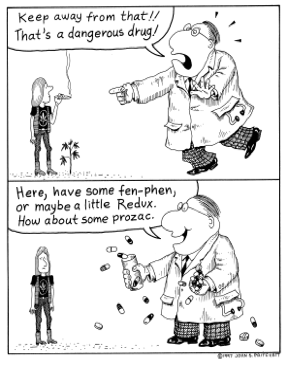
That pathologization has spread to drug consumption in similar ways. Though drugs have been handled differently in our laws compared to alcohol, they too have been medicalized in our culture. Just like you can go to an AA meeting, you can go to a meeting for Narcotics Anonymous, or Crystal Meth Anonymous. Name your "problem" drug, and there is a 12 step solution for you out there. For every drug, there is a support group saying "we know, you couldn't help it, but now we can help you."

There is a positive and a negative impact from this pathologization. It takes the blame off of the individual, in one way, but puts it right back on them with the label of "sick." Is that a fair trade off?


Is drug use a problem? If so, how much is too much? How should it be regulated? Who should decide when it is too much, legally, or medically? How, as a society, should we handle drugs? How have we reacted to the use of drugs we have chosen to make illegal? Are some drugs more deviant than others? Does the deviant label depend on your race, class, gender, ability, et al.?


If you look at the billboards out there trying to stop people from doing crystal meth, they give a very particular message--don't use meth, because it will make you ugly. Are scare tactics the answer? If drugs are a problem, are scare tactics the answer? Research says that youth overestimate the impacts of cigarettes--they actually think they are more harmful than they really are. But that doesn't stop them from smoking. Smoking is cool, and youth often feel invincible.


Is it ever deviant to not do a drug? Is there a pressure to participate in some consumption, such as alcohol or pot? Why is pot a controlled substance? Has it always been illegal? Why is it still illegal? Pot is a great example of a form of deviance being a social construction. It wasn't illegal in the United States. And then it was. And how it became illegal was largely based in politics and lobbying, not for medical reasons, or because of crime problems. To justify making it illegal, the culture had to reframe the way they thought about pot. They had to start seeing it as a "problem" that needed to be controlled, in the eyes of the public, and in the ears of the legislators. Some groups helped to make this happen by using propaganda, including the infamous film Reefer Madness (1938), filled with scare tactics (you've got to protect the children!).


If you really dig into the history of how pot became illegal, you will see it wasn't to help society, it was to make money. And they used racist insecurities and fears to turn the country against a substance they once enjoyed, or at least viewed as neutral.


Why does a society control alcohol and/or drugs? Do we need the government to save us from ourselves? Or is it because controlling alcohol and/or drugs helps society? Certainly, drugs and alcohol cost society, in car accidents, health care, and lost productivity taking away from our economy. But are there also benefits to the consumption of drugs and alcohol?

I gave you two readings about the social harm of drugs. What does the most harm? If we are really legislating drugs to help society, why are we not controlling the drug that causes more harm than all the others, by far--alcohol? Who has the best political lobbyists? Who stands to make money by alcohol sales? If pot could make that much money for some people, would it suddenly be legal? If marijuana had the same political power as alcohol, what would happen? Would it be legal? Could it not just be legal, but woven into our culture as the ultimate party device, as alcohol is?


We have a twisted relationship with alcohol in our culture. We love it, it makes you sexy and cool, but don't drink too much....because that's sick. Why? Why are prescription drugs not treated the same way? Who can afford prescription drugs, and who can afford "street" drugs? How does that influence how we see deviance? Our definitions of deviance, when it comes to drugs and alcohol, are complex, and our messages often contradict each other.
February 27, 2012

Blog Post 4: Story of an Illness

For this section of the course, we are talking about how some people get labeled "sick" for the way their minds work. This is an extremely difficult topic, with much emotion and controversy wrapped up in those labels. It seems that some behaviors people used to shrug off as somewhere in the range of "normal" are now considered problematic. And some behaviors that used to be seen absolute as a sign of mental illness (like homosexuality) are no longer perceived that way (at least by most).

For some, getting a label of a mental illness has been life-saving and affirmative. Not only does it offer them an explanation for whatever symptoms they have been experiencing, but it also offers a chance at treatment. And, because we rely so heavily on insurance, receiving an official diagnosis is often a necessary step for getting therapy and/or treatment. Being given a label has also meant that individuals facing similar issues, barriers and concerns can form community together, and bond over their common experiences. With all of our technological advancements, we keep learning more about the body, and our brains--so are these new and expanded labels helpful? Are they getting us closer to the truth?

One of the downsides to getting a label of mental illness is the stigma that comes with such labels. Such a stigma is potent, because, as we have discussed about labels, they come with a whole package of assumptions. We see people with mental illnesses as "sick" but what else comes in that package--sick? Crazy? Unstable? Dangerous? What happens when your mental illness becomes your master status? Once you have been labeled, are you seen the same by society? Do you still have the same opportunities as everyone else? Or do your choices become more constrained?

One of my favorite examples of this quandary--should we accept this label or not?--is in a really fascinating story of Emanuel Frowner, from the outstanding podcast Radiolab. In the story of the Frowners, the father of the family refuses to believe that Emanuel has any problems, but his other son can see that Emanuel has textbook symptoms along the autism spectrum. Dad wants to avoid Emanuel being treated differently, but his brother wants him to get help--what is ultimately the best thing for Emanuel? The story is moving, and even the comments on the web site are telling about how difficult these decisions are. The clip is about 19 minutes, and is well worth a listen (sorry about the ad!).

There are also more sides to this discussion. For example, who stands to benefit from more widespread diagnoses of mental illnesses? Certainly, pharmaceutical companies stand to make enormous amounts of money from some diagnoses. As we have touched upon in class, there is much more money to be made in treatment than prevention. Does having the potential for profits change the way such companies look at medicine? Are these companies doing great work to solve our health problems, are they looking at more markets to tap, are they impacting policy in powerful ways, or or is there even more going on? What should be the role of drug companies in educating doctors, or the public, about medicine?


The Diagnostic Statistical Manual (DSM) is called "the bible" when it comes to diagnosing mental illness. The DSM-V is scheduled to be released in May 2013 and the process of updating it has been nothing short of intense. Right now at least 8 conditions considered "disorders" will be removed. Various groups have lobbied, protested or fought in a myriad of ways to get their illnesses labeled, so they can get health care, or removed altogether. And those groups are infighting with each other, because some want the label to access health benefits, and others are fighting the stigmas. Should this be how diagnoses are made? By political lobbies and activism, or are decisions made based on sound scientific evidence? And who pays for that scientific evidence--it really gets that messy. On top of everything, many of the people charged with updating the new DSM-V clearly stand to make a lot of money on the very changes they are voting on--should this conflict of interest, which impacts up to 70% of the panel members, be allowed?

For your fourth blog post, you will do your best to disentangle all of this in regards to an "illness" of your choosing. You can choose something that used to not be labeled an illness, but is now, or something that is no longer considered an illness. Or something that is currently going through a surge of awareness, and heightened diagnoses, like autism or ADHD (both of which we will begin to discuss in class). Really, it can be any illness you want to know more about. More than giving a history, you are going to give us an analysis of what has been involved in the process of this illness gaining, or losing, that label. You are going to tell us the academic story of that illness.

Choose something that has been deemed an "illness" either informally, or formally in the DSM. Not necessarily eyelashes--try to take on something with broader implications. Give a brief history of the diagnosis, or medicalization of that illness, then give a sociological analysis of the illness, using questions like these:
  • What were the behaviors or attributes that were seen as deviant, and how did they become seen as deviant/normal?
  • What was the process of medicalization (or demedicalization?) for this illness?
  • Who were the major players in the decision-making process, as far as you can find?
  • What parties stand to gain from the diagnosis?
  • What parties stand to lose from the diagnosis?
  • Are the people that will be impacted by the label part of the conversation, at all?
  • How did/does information spread about this illness?
  • What were/are the roles of social institutions in creating/maintaining the "sick" label?
  • What are the consequences (positive and negative) of having this diagnosis?
  • Are some groups more or less likely to be diagnosed with this illness?
  • What are the underlying social constructions of race, class, gender, size, ability, sickness, mental health, age, beauty, normal, deviance, sexuality, and so forth that impact this illness, and/or its perception?
  • Once this label is assigned, do we as society take any responsibility for the care of those who are labeled? Should we?
  • Who benefits from this illness being seen as an individual problem?
  • What are the possible social reasons for the existence of this illness?

A thorough post will include as many sides of the discussion as possible, to try to show just how complex this all is, and will do a really solid job of connecting to the concepts and materials from the course to their examination. My standards are only increasing; if you have any doubts, make sure you visit the writing center. At this point we should be past any typos or citation errors. Remember you must utilize and cite at least three of the assigned course materials, and you must EXPLAIN sufficiently how they connect to your analysis.

Not sure where to start? Here are a few suggestions, and some links to some places to start your thinking (also, of course, look at the required readings). Once you choose one, if you need some guidance, feel free to email me and/or set up a time to talk--I am always happy to bat around ideas with students. You will probably find you need to go back into the deviance blogs, so you can make sure you are getting a wide representation of perspectives and voices on the impact of these deviant labels (see the list on the right side of the page).

This is not necessarily reflective of what is "out there" but is just pulled from my personal collection I have gathered over the past few years of teaching this course.

Autism/Asperger's
ADD/ADHDGender Identity DisorderHomosexualityAlcoholism/Drug AddictionObesityDepression/Mental Illness (sorry to lump these--please be more specific in your own project)
Developmental, intellectual or physical disabilities (sorry to lump these--please be specific for your own project)
Sex AddictionViolenceBonus thoughts:

February 3, 2012

Section 3 :: Deviant Bodies (Part II: Feb 14, 16 and 21)

For the last three days of this section, we are going to be discussing other types of deviant bodies. We are going to discuss our obsession with size, and the beliefs we have about overweight bodies. Then, we are going to discuss bodies that are seen as disabled, and the limits of our beliefs about what constitutes "ability" and "disability."

As with all of the groups we discuss this semester, members of the fat and disability community are both challenging us to think about how we define "normal." In our images of ideal men and women, we have very specific ideals for what we think bodies should look like, and how they should function. If you look around, you will see that almost all aspects of our culture is based on an assumption that we meet the ideal, or pretty close. Look at the classrooms on campus--do the chairs, desks and rows make assumptions about your body size and shape? What are they assuming about your physical abilities? Next time you go to a store, look--would you be able to get into the store, if you were in a wheelchair? Does the layout of the store make assumptions about your body, in size and ability? If they sell clothing, do they sell clothes that would fit any type of body, based on size or ability?

Both weight and ability are a master status, so when you are not the ideal size (which has nothing to do with averages, or reality), or have a visible disability (which has nothing to do with your actual capacity), you are seen first and foremost by that status. Your actions and words get put through the filter of assumptions we have about fat and disabled bodies. For example, in both communities, there is a perception that when you are fat or disabled, you are asexual. Mainstream society has a hard time believing you can be attractive, attracted and sexual. You are considered deviant if you want to have sex with someone fat or disabled. Why? What are the underlying assumptions and social constructions? How does this relate to our ideas of "ideal women" and "ideal men"?


On February 14, we will talk about fat bodies (I use the term "fat" in reference to the fat acceptance movement). We will ask where our beliefs about people who are fat come from, what that means for the lives of those who receive the "fat" label, and the consequences of the stigma that comes with that label.

Required:


On February 16, we begin talking about people with disabilities, and our assumptions behind that label. What constitutes "abled" or "disabled" and who gets to choose where to draw the line between those two labels? Some people get from point A to point B by walking. Others roll. Who says one way is better? How does all of this work with our images of the ideal man and woman? What are the consequences of being labeled "disabled" in our society? What do we think we know about people, based on their disability as a master status?

Required:


On February 21 we will finish this section of the course by watching the film Murderball and completing our discussion of what it means to be able-bodied. Be excited to see this documentary--not only will it blow you away, but the star of the film Mark Zupan will be coming to WSUV as the Marquee Diversity speaker on March 7! Here are the details. Reserve your seats now!

Required:


Bonus: Mark Zupan in Jackass Number Two!

January 31, 2012

It's Dangerous to be Different

We have talked in this class about how, when you are seen as "the other" your behaviors are more likely to be interpreted as deviant. That can be because your master status is non-white, or non-Christian. It is because you are "the other" that you are suspect.


http://bestmoviesevernews.com/paradise-lost-3-purgatory-movie-review-2905/

This was the case with the West Memphis Three. Maybe you have heard about this case. It has now been the subject of a trilogy of films, called the Paradise Lost series from HBO. These three young men (Damien Echols, Jessie Misskelley, Jr. and Jason Baldwin) were suspected of, and eventually incarcerated for, the brutal murders of three young Cub Scouts in 1993. They did not commit the crime, but that did not seem to matter as the case unfolded. Their only "deviance" was not criminal at all--they were just different. They listened to Metallica, wore black clothing, and did not choose to follow mainstream trends. But they were the primary suspects, and the case became a witch hunt, with the agents of the local criminal justice system determined to find the young men guilty. They blamed the murders on the satanic rituals of the suspects, and got the community into a frenzy of beliefs about them, based on their appearance and musical taste.


When the first documentary was released, a lot of attention from the public and some celebrities followed. Johnny Depp, Peter Jackson and Eddie Vedder gave millions of dollars to help free the men, and a trust fund was set up to help provide financial support to the prisoners.

The three men were recently let out of prison--but with a pretty big hitch. They were forced to plead guilty. So now, the case is closed, and the real killers may never be caught, despite pleas from the parents of the murdered boys, and continued pressure from activists like Johnny Depp to keep searching. The 3rd film in the series chronicles this chapter in the story. The case is fascinating, and I highly recommend learning more about it.


Here is a recent NPR story about the release of the men from prison. It is an interview with the director of the three
Paradise Lost films. You can listen or read.

January 20, 2012

Master Status

We did not get a lot of time to talk about Master Status in class, but it is a concept we will be revisiting throughout the semester.

When something becomes your Master Status, it is then the first thing about you that people notice. If you are the default--white, male, heterosexual, able-bodied, cisgender, etc.--those are your master statuses, and because of those, positive or neutral assumptions are made about you. You are given the benefit of the doubt; people get to know you a little better before they label you. When you have something about you that is different--you are a person of color, female, queer, disabled, fat, gender non-conforming, etc.--that/those become your Master Status(es). Everything you do and say gets filtered through our associations we have for those labels. Think about the "My Gay Lifestyle" article, and how he pokes fun of this.

If you are a woman, everything you do and say gets filtered through expectations for how a woman is "supposed to" look and act. Are you saying that because you are a woman? When you act like that, does it fit in with my beliefs about women? Or are you acting against my expectations for you? If you are a woman, and pretty, and blonde...what do people assume about you? That you are dumb. Is that fair?

If you are not white, your race or ethnicity is probably your Master Status, or what people notice about you first. As soon as people notice you are not white, everything you do and say is filtered through the associations we have been socialized to have for your race: you do not just eat breakfast, you eat breakfast as an Asian-American. Or you cross the street as a Latina--in that case you are not white, and you are female, with those interacting assumptions.

As you read in the BBC article, the Master Status can even confer meaning to the people you are around. In that article, they talked about a study in which women were asked to look at a photograph of a man and woman standing together, then rate the man using 50 available words. As you remember, when the man was pictured with an obese woman, they were more likely to rate the man as "miserable, self-indulgent, passive, shapeless, likes food, depressed, weak, unattractive, insignificant and insecure."

When you are interacting with people, you are making associations, positive and negative, with each other and your varying Master Statuses. When people act in ways that conform with our beliefs, and expectations, based on those Master Statuses, that feels comfortable to us. We know how to relate to each other because we know how we fit in with them, and rank compared to them. We still know our place in the world. But when we get evidence to the contrary, that people do not meet our expectations, it is uncomfortable. You don’t know what to expect from that person, and you don't know how you relate to them, or how you rank compared to them.

If you think about the War Prayer story, what happened there? The congregation did not want to have to change the way they thought about themselves, so they demonized the messenger. They discredited him so they would not have to look inward to see they were wrong. Can you see that is how we hold on to some of our socially constructed beliefs? It is hard for us to see past those labels, that Master Status, so we hold on to them. We rely on Confirmation Bias to provide evidence for our beliefs, and we ignore evidence to the contrary.

Some people actively ask us to see past the Master Status they have been given, like Ben Mattlin asks us to see he is not defined by Spinal Muscular Atrophy. In November 2011, ABC's 20/20 aired a program called "Children of the Plains" in which they showed the Lakota Indian Reservation in South Dakota. They showed how the reservation is struggling with issues of crime, unemployment, alcoholism and crumbling schools. The students of one of those schools got together and made a video response saying they were more than just those images--they were more than just poverty and struggles. This was a conscious effort on their part to say they did not want to be boiled down to a negative Master Status based on those associations. Below is the video they made. What do you think?

January 6, 2012

Section 1 :: Who/What is Deviant?

For the first two weeks of class (January 10 - January 19), we will be discussing who and what is considered deviant in society. While we will discuss how definitions of what is "normal" and "deviant" varies widely by geographic area, for this course, we will primarily be focused on the United States.

Remember, you are expected to have read, watched and digested all of the assigned items, and be ready to discuss them in class on the date listed. There will be times when we do not discuss those concepts on the exact date, but we will eventually, and you are expected to keep up, and contribute mindfully.

For January 12 you will be exploring the topic of privilege. This is a difficult topic for many, and puts a lot of people on the defensive. Right out of the gate, you are going to find out you need to have an open mind to enjoy this class. The concept of privilege refers to the "unearned advantages" some people get, and some people do not, just because of their race, class, gender, ability, size and so forth. This concept will be fundamental to our future explorations in this class, so make sure you have a good grasp, and come to class with questions.


These articles will also begin to touch on the concept of master status. Our master status is the first thing people notice about us, and use to determine who we are. When you are 18-22 and walking around campus with a backpack, people think "student" and from there, they assume attributes that go along with the role of "student" such as busy, tired, or party animal (well, hopefully not). When you are something that is considered "deviant" by society, that often becomes your master status, or your defining attribute. When you are in a wheelchair, that is the first thing people see about you, and they will make a host of assumptions based on your status as a person with disability. Maybe they will feel sorry for you. Maybe they will think you must be SO brave. When you say something, they will filter your words through "well, he or she is saying that as a person in a wheelchair." We will talk about this much more in class. You will see that these concepts are connected. When you are labeled "deviant" in our society, you are seen in terms of your master status. When you are seen as "normal" you are not--and that is a privilege. In your assigned items, you will see two "privilege checklists." These were inspired by this article: White Privilege: Unpacking the Invisible Knapsack by Peggy McIntosh.

Required
What is cisgender? It is someone who identifies with the gender assigned to them at birth. Learn more here.
Optional:
On January 17 we will start discussing how what we consider "deviant" is really just a social construction. For example, what we consider to be "deviant" changes greatly over time. It used to be considered deviant for women to wear pants. Now it is "normal." Cocaine used to be a popular medical remedy, now it is illegal. We will discuss many more examples in class, and I would also love for you to think of your own to share with us. We will talk about social constructions in general, how "deviance" is one, and what the consequences are of being labeled deviant. We will also be discussing who gets to decide who and/or what is considered deviant.

Required:
  • Read "Images of Deviance" by Stephen Pfohl in your textbook.
  • Read "Defining Deviance Down" by Daniel Patrick Moynihan in your textbook.
  • Read "Outsiders: Defining Deviance" by Howard Becker, available on Angel.
  • Read "Stigma of Having Obese Friends" on BBC News.
On January 19 we will complete this section, talking about WHO we consider deviant in our culture and HOW we know they are. Come prepared to talk about the following items:

Required:
  • Read "The Saints and the Roughnecks" by Williams Chambliss, available on Angel.
  • Peruse the blog Microagressions. The posts change frequently, so consider looking back a few times. Come to class prepared to talk about the ones you found most interesting, disturbing and/or confusing.
  • Listen to the clip "Spinal Muscular Atrophy 'Doesn't Define Me'" on NPR (transcript available on the same page).
  • Read the article "Media Binge" from the sociological journal Contexts.
  • Watch both of the following clips from ABC's "What Would You Do?"
Part 1:

Part 2: